
Affiliate marketing looks simple from the outside: recommend products, share links, earn commissions. But anyone who has tried it for more than a few weeks learns the truth fast—most affiliate income isn’t built by a single clever tactic. It’s built by the quiet, repeated work that makes people trust you.
The reality is that affiliate marketing is a long game. Not because it’s slow by nature, but because the two things that create durable results—trust and habit—take time to form. And the engine that powers both is consistency.
Consistency isn’t just “posting a lot.” It’s showing up with the same standards, the same values, and the same helpfulness even when you’re not getting likes, clicks, or sales. When you combine that consistency with leadership (how you guide your audience) and trust (how safe people feel following your recommendations), you get something most affiliates never reach: long-term profits that don’t disappear the moment a trend ends.
Let’s break down how this works—and how to build it.
Why Consistency Is the Most Underrated Skill in Affiliate Marketing

Most people treat affiliate marketing like a lottery ticket. They throw up a few posts, add links, wait for money, and quit when results don’t come fast enough. The problem isn’t that affiliate marketing “doesn’t work.” The problem is that audiences don’t trust inconsistent creators.
Here’s why consistency matters more than almost any other skill:
Attention rewards repetition. People need to see your name, your message, and your style multiple times before they remember you.
Trust is built through patterns. When you consistently help someone, they start believing you’ll keep helping them.
Platforms reward reliability. Whether it’s search engines or social feeds, consistent publishing and engagement makes your content easier to discover over time.
Your own skills improve faster. The more you write, review, test, and refine, the better your content gets—and better content converts.
Consistency isn’t exciting, and that’s the point. It doesn’t feel like a “hack.” But it’s the closest thing affiliate marketing has to a guaranteed advantage.
The Big Shift: Consistency Over Intensity
Many affiliates start with intensity: daily posts for a week, a burst of energy, then silence. That approach is exhausting—and it doesn’t create compounding results.
A better strategy is consistency over intensity:
Instead of 7 posts this week and 0 next week, do 2 posts every week for months.
Instead of rewriting your entire site, improve one page each week.
Instead of promoting 10 offers, build deep trust around 1–3 that truly fit your audience.

People don’t trust random bursts. They trust creators who show up predictably.
If you want long-term profits, your goal is to become someone your audience can count on—because predictable creators become familiar, and familiar creators become trusted.
Leadership: The Secret Ingredient Most Affiliates Ignore

When people hear “leadership,” they think of managers, CEOs, or famous influencers. But in affiliate marketing, leadership is simpler:
Leadership is how you guide decisions.
If your content only says, “Buy this,” you’re not leading—you’re pushing. Real affiliate leadership looks like:
teaching people how to think about a purchase
helping them avoid mistakes
showing pros and cons honestly
recommending what fits different types of people
staying consistent even when it’s tempting to chase easy commissions
Leadership is what makes your audience feel like you’re on their side.
And when you lead well, the affiliate links stop feeling like ads and start feeling like a helpful shortcut.
Leadership sounds like:
“Here’s what to look for before you spend money.”
“This is who this product is for—and who should skip it.”
“If you’re on a budget, start here. If you want premium, consider this.”
“I used this approach and here’s what surprised me.”
That tone is powerful because it creates trust.
Trust: The Real Asset Behind Affiliate Profit
Affiliate marketing is basically a trust transaction. Your audience is thinking:
“If I click your link, am I making a good decision—or are you just trying to get paid?”

If you can answer that question with your behavior, you win.
Trust increases:
click-through rate (people actually follow your recommendations)
conversion rate (they buy after clicking)
repeat purchases (they come back for your advice again)
audience loyalty (they share your content and tell others)
Trust also protects you long-term. When platforms change, trends shift, or a product stops being popular, a trusted affiliate can pivot without losing everything—because the audience is attached to the person, not just the topic.
How to build trust faster (without being “salesy”)
Be transparent. Clearly disclose affiliate relationships in a simple way.
Recommend selectively. Fewer offers + stronger belief = better conversions.
Explain your reasoning. People trust explanations more than hype.
Show outcomes. Share results, comparisons, and real use cases when possible.
Admit limitations. “This isn’t for everyone” builds more credibility than “best ever.”
Trust isn’t built by sounding confident. It’s built by being consistent and honest.
Ethical Promotion Is Not Optional If You Want Long-Term Income
There’s a shortcut path in affiliate marketing: exaggerate benefits, hide downsides, push whatever pays the most. That can generate short-term spikes… and long-term damage.
If your audience feels tricked once, the relationship changes. They don’t just stop buying—they stop believing.
Ethical promotion is what keeps trust intact for years. It includes:
clear affiliate disclosures (no hiding)
honest pros and cons
refusing offers that don’t match your audience’s needs
not promoting products you don’t understand
avoiding fear-based pressure (“buy now or you’ll fail”)
Long-term affiliates behave more like advisors than advertisers.
A Practical Consistency System (That Doesn’t Burn You Out)
Consistency is easiest when it’s not based on motivation. Motivation fades. Systems stay.
Here’s a simple system you can use:
1) Pick a single content “lane”
Choose one main content category for 60–90 days, such as:
product reviews in a niche
beginner guides for a topic
comparisons and “best of” lists
tutorials that naturally include tools/products
Staying in one lane helps you build authority faster.

2) Create a repeatable weekly schedule
Example:
Monday: write or outline one helpful post
Wednesday: publish + share it
Friday: update one older post or create a short post/social snippet
This is manageable and builds momentum.
3) Use a simple content template
Templates reduce decision fatigue. Examples:
Problem → options → recommendation → who it’s for
Comparison → key differences → best for each type
How-to → steps → recommended tools → common mistakes
4) Track the right metrics
Vanity metrics (likes, views) can mislead you. Instead track:
clicks to offers (interest)
conversions (performance)
email signups (trust building)
repeat visitors (loyalty)
time on page (content quality)
Consistency means improving what matters—not just posting more.
The Compounding Effect: Why Consistent Affiliates Win
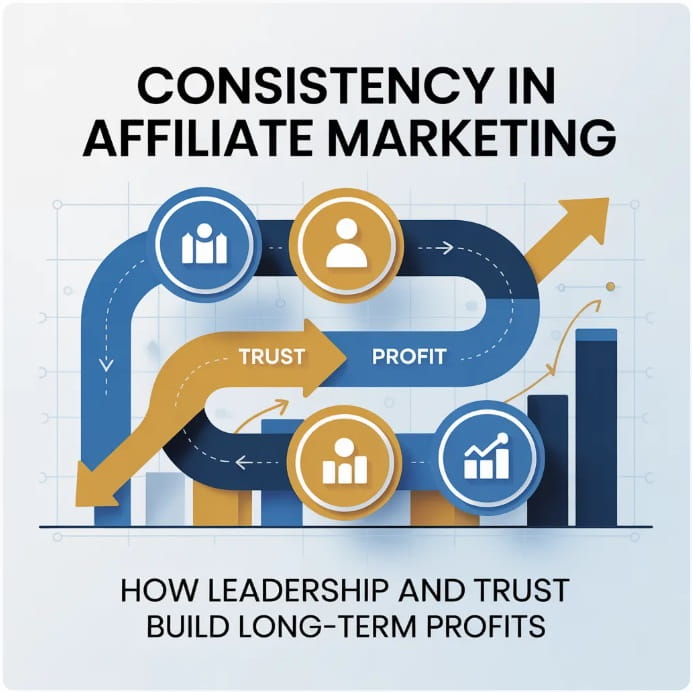
Affiliate marketing “compounds” in a few ways:
Content compounding: old posts keep ranking, driving traffic long after they’re published
Trust compounding: each honest recommendation increases confidence in the next one
Skill compounding: your writing, strategy, and conversions improve with reps
Audience compounding: loyal followers share your content and bring new people
This is why leadership and trust matter so much. You’re not just posting content—you’re building an asset that grows over time.
30-Day Consistency Checklist for Affiliates
If you want to turn this into action, here’s a practical 30-day plan.
Week 1: Foundation and clarity
Choose one niche topic and one audience problem
Pick 1–3 affiliate products that truly fit the problem
Write a simple disclosure statement you’ll use consistently
Outline 4 blog post ideas in the same lane
Week 2: Publish and build credibility
Publish 1 in-depth post (guide/review/comparison)
Add a “who it’s for / who it’s not for” section
Share the post in 2–3 places (social, community, email if you have it)
Track clicks and reader questions
Week 3: Strengthen trust signals
Publish a second post (different angle, same lane)
Add FAQs based on comments/questions
Improve internal links between your posts
Update product descriptions to be clearer, less hype
Week 4: Optimize and lock in the habit
Publish a third post
Refresh one older post with better headings or examples
Review your metrics and identify:
which content got the most clicks
which offer got the most conversions
what readers asked for next
Plan next month’s 4 post topics based on what worked
This checklist is intentionally simple because consistency beats complicated plans.
Final Thoughts: Long-Term Profits Come From Long-Term Behavior
Affiliate marketing isn’t about posting links everywhere. It’s about becoming a reliable guide.
When you show up consistently, you signal stability. When you lead with clarity, you signal responsibility. When you promote ethically, you protect trust. And when trust becomes your brand, profits become steadier—because your audience believes you.

If you want to build affiliate income that lasts, make this your rule:
Be consistent enough that people feel safe following your recommendations.
That’s how leadership and trust turn into long-term profits.