

The Modern Affiliate Marketing Arena
Affiliate marketing works like a performance sport. You are paid for outcomes, not simply for effort. Clicks, leads, and purchases are the scoreboard, and ultimately, the scoreboard determines how well your strategy performs.
For anyone asking affiliate marketing what is it, the basic concept is straightforward: you promote another company’s products or services and can earn a commission when someone completes a qualifying action through your referral. That simple affiliate marketing definition explains the mechanics, but building a successful business requires much more than placing links online.
There is no salary waiting at the end of the month. If an offer does not convert, there may be no commission. That performance-based structure is part of what makes affiliate marketing attractive to driven entrepreneurs, but it can also be challenging for anyone who approaches it like a casual side hobby without a practice plan.
For people researching what is affiliate marketing and how does it work, it helps to think of the business as a connection between three sides: the merchant, the affiliate, and the customer. The merchant provides the product. The affiliate attracts and educates potential customers. The customer decides whether the offer is right for them.
That is the practical affiliate marketing meaning behind the business model.
In this environment, attention is the currency you compete for first. Conversions come later. The challenge is that attention is already being earned and purchased by thousands of other creators targeting similar audiences.

Where the Battles Happen Today
The affiliate marketing “arena” is not a physical place. It is a collection of competitive channels where audiences spend their time and platforms determine what receives visibility.
Search results are one battlefield. Rankings influence who gets the click, and strong positions can generate significant organic traffic.
This is why understanding affiliate marketing keywords can become an important part of an SEO-based strategy. Instead of creating random content, affiliates can identify the questions and search terms their audience is already using.
Social media feeds are another arena. A post can reach thousands of people or receive little distribution depending on engagement, timing, relevance, and platform algorithms.
Email inboxes are quieter but can be highly valuable. An email that reaches an interested subscriber can sometimes produce more meaningful engagement than a social post viewed by a much larger but less targeted audience.
Paid advertising adds another dimension. You pay for attention and then attempt to turn that attention into measurable results. Bids, creatives, landing pages, tracking, and conversion rates all influence whether a campaign performs.
Successful affiliate marketing online rarely depends on only one of these channels. Diversification can reduce dependence on a single traffic source.

The Key Players and Power Dynamics
Affiliates take much of the performance risk. They invest time in content, testing, and sometimes advertising, but compensation depends on results.
Merchants determine products, prices, and commission structures. An affiliate marketing network may provide tracking infrastructure and connect merchants with publishers. Platforms control distribution and advertising policies.
There are also many different affiliate marketing programs, ranging from individual company programs to larger networks containing numerous offers.
This is why beginners searching for the top 10 affiliate marketing websites, best affiliate marketing websites, or other affiliate marketing sites should look beyond commission percentages.
The quality of the product, tracking reliability, payment terms, brand reputation, and relevance to your audience can all matter.
Different affiliate marketing brands also impose different promotional requirements. Understanding those rules before promoting an offer can prevent problems later.
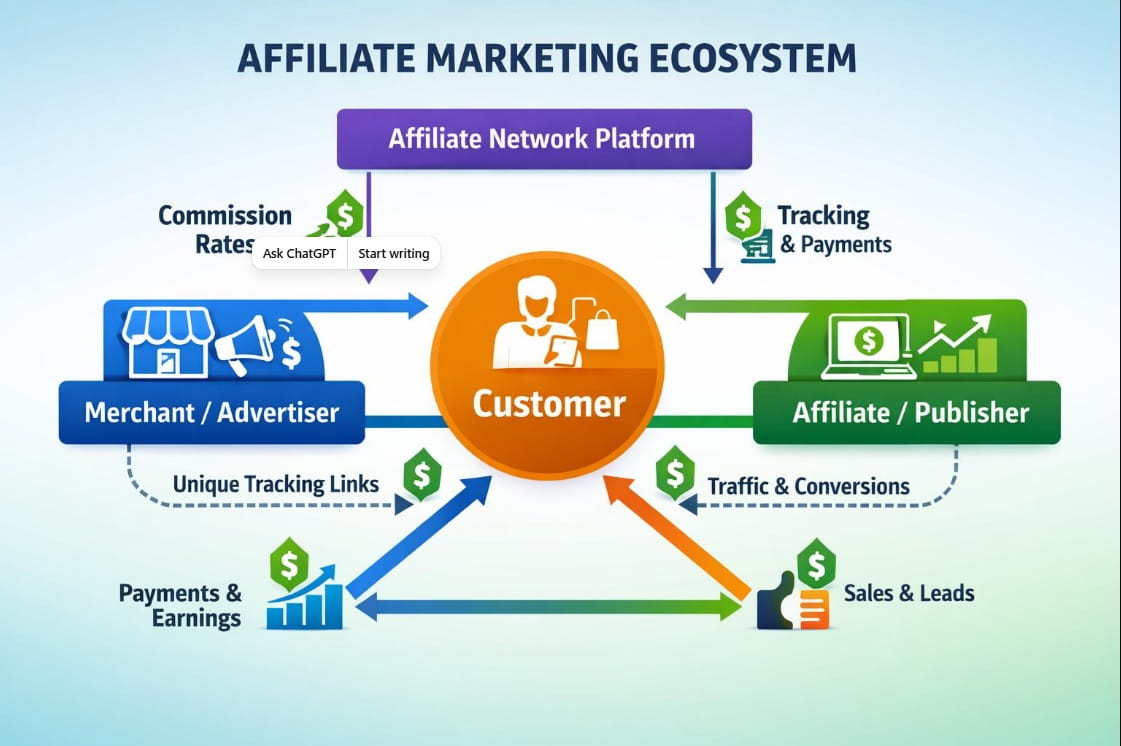
What Affiliates Control and What They Do Not
Affiliates control their message, angle, content, and the path a visitor takes before reaching a merchant.
You can choose which problem to address, what proof to present, what objections to answer, and how to frame a recommendation.
You also control your testing discipline. You determine how quickly you iterate, how carefully you measure results, and whether you improve your weakest point or continually start over.
What you cannot control are platform algorithms, merchant landing pages, fulfillment quality, commission changes, or tracking policies.
This distinction is central to understanding how does affiliate marketing work as a sustainable business rather than simply a promotional tactic.
Smart affiliates gradually build assets they control.
Stability comes from ownership, not luck.

The Core Weapons of High-Performing Affiliates
High-performing affiliates treat their resources like professional tools: they learn them, maintain them, and continually improve how they use them.
Common affiliate marketing tools include landing-page builders, email marketing platforms, analytics systems, keyword research tools, link management solutions, and tracking platforms.
Depending on the complexity of the operation, dedicated affiliate marketing software can also help organize campaigns, track conversions, and evaluate performance.
Technology is changing this toolkit as well. AI affiliate marketing can involve using artificial intelligence to assist with research, brainstorming, content workflows, audience analysis, or campaign optimization.
Similarly, affiliate marketing using AI can make repetitive parts of the workflow more efficient. However, AI should support judgment rather than replace it. Trust still depends on useful information and responsible recommendations.
The fundamentals remain funnels, email, creative strategy, trustworthy content, and disciplined testing.
Small improvements compound.

Funnels and Landing Pages That Convert
An affiliate marketing funnel is a controlled customer journey.
Instead of immediately sending visitors to a merchant and hoping they purchase, a funnel can guide people through information appropriate to their current level of awareness.
For cold traffic, the first job is clarity.
What is this?
Who is it for?
What problem can it help solve?
If those answers are not obvious quickly, visitors may leave.
Landing pages work best when they reduce friction. They usually provide one clear primary action, remove unnecessary distractions, answer important questions, and establish realistic expectations.
The best strategy for affiliate marketing is rarely about maximizing the number of links on a page. It is about creating a logical path between the visitor’s problem and a relevant solution.
Your affiliate marketing links should therefore appear where they genuinely help the reader take the next step rather than being inserted everywhere simply to increase clicks.

Email Lists and Sequences You Truly Own
An email list is one of the few audience assets an affiliate can substantially control.
Social platforms can reduce organic reach. Search rankings can change. An email list gives you a more direct relationship with people who have voluntarily subscribed.
Ownership does not mean constantly sending promotions. The objective is to create a communication channel where subscribers expect useful guidance, honest recommendations, and relevant follow-ups.
Sequences matter because many people do not purchase after their first interaction.
A well-designed sequence can educate, answer objections, explain use cases, and introduce an offer when appropriate.
This can work particularly well when promoting affiliate marketing digital products, where customers may need additional information to understand what they are buying and whether it fits their needs.

Hooks, Creatives, and Headlines That Win Attention
A hook is the first meaningful moment of interest.
It makes someone stop scrolling, begin reading, or click.
Effective hooks are specific. They address a recognizable problem, desired outcome, or unexpected contrast.
Headlines perform a similar function. They communicate a benefit, introduce a mechanism, or highlight a mistake the audience may want to avoid.
Creatives then have to carry that promise.
If an advertisement says something is simple, the next step should feel simple. If your video promises a quick explanation, it should deliver that explanation efficiently.
Mismatch damages conversions and trust.
Studying successful affiliate marketing examples can help you understand how creators connect hooks, content, calls to action, and offers. The objective is not to copy them but to understand the underlying structure.

SEO and Authority Content for Compounding Traffic
Search traffic can take time to develop, but well-positioned content can continue attracting visitors long after publication.
Authority content is not simply long content. It needs to be useful, accurate, and aligned with search intent.
A person searching for affiliate marketing reviews, for example, likely wants evidence, advantages, disadvantages, comparisons, and enough information to make a decision.
Someone searching affiliate marketing how to may instead need step-by-step educational content.
Other visitors may search questions such as is affiliate marketing legit or is affiliate marketing worth it. These queries should be answered transparently rather than with exaggerated promises.
Affiliate marketing is a legitimate performance-based marketing model, but that does not mean every course, offer, program, or income claim associated with it is trustworthy.
Strong SEO content addresses these distinctions.
It also targets relevant topics across different affiliate marketing niches, reducing dependence on one page or keyword.

Paid Traffic and Testing for Predictable Scale
Paid traffic can help affiliates gather data quickly, but it can also consume a budget quickly when testing is poorly structured.
A campaign should begin with controlled variables: a defined audience, one primary angle, a manageable group of creatives, and a landing page aligned with the message.
Testing becomes more useful when you treat it as measurement rather than gambling.
Define what success means. Establish a learning budget. Measure the results. Then decide what deserves additional investment.
Predictable scaling can begin after you identify a combination of audience, message, funnel, and offer that produces repeatable results.
This testing process is an important component of any serious affiliate marketing strategy.
For someone wondering what is affiliate marketing strategy, it is essentially the structured plan used to choose an audience, select offers, generate traffic, convert visitors, measure performance, and improve results over time.

Risk vs. Reward in Affiliate Marketing
Affiliate marketing offers flexibility and potential upside, but it also involves risk.
Time goes into content and funnels. Money may go into tools and advertising. Reputation is involved every time you recommend a product.
This becomes particularly important with high ticket affiliate marketing, where products or services carry higher prices and potentially larger commissions. Buyers generally require more information and trust before making a significant purchase.
For this reason, high ticket affiliate marketing for beginners should not be approached simply as a way to chase larger commissions. The product still needs to match the audience, and the affiliate needs enough understanding to communicate its value and limitations responsibly.
A repeatable process is generally more valuable than a single lucky campaign.

Why Most Beginners Lose Early
Many beginners enter affiliate marketing expecting quick results and interpret early failures as evidence that the model does not work.
Others skip fundamentals. They publish content without understanding their audience, run paid traffic without proper tracking, or promote products they barely understand.
This is why affiliate marketing for beginners should start with fundamentals rather than income expectations.
People searching for the best affiliate marketing for beginners should focus on finding a manageable niche, a credible offer, one primary traffic method, and a simple measurement system.
Likewise, affiliate marketing strategies for beginners should initially be simple enough to understand and repeat.
There are plenty of affiliate marketing for beginners free resources available online, and these can be useful for learning terminology and basic concepts before paying for advanced education.
Structured affiliate marketing training can also help when it provides practical guidance, realistic expectations, and clear implementation steps.
The early stage is primarily training.
Results come after repetitions.

The Warrior Mindset: Turning Losses Into Data
High performers treat losses as information.
A failed campaign is not an identity verdict. It is a signal.
Did the hook fail to generate attention?
Did the landing page fail to continue the promise?
Was the audience wrong for the offer?
Did the follow-up fail to establish sufficient trust?
This approach transforms failure into actionable data.
It also applies when deciding affiliate marketing how to start. You do not need to understand every strategy before beginning. You need enough knowledge to run a small, responsible test and learn from what happens.
Instead of hiding from the numbers, examine them.
Instead of blaming the platform immediately, isolate the variables.
Then make the next attempt better.

How to Study Failed Campaigns and Improve Fast
Start with the simplest metric showing where performance broke down.
If click-through rate is weak, investigate the creative, hook, or targeting.
If clicks are strong but opt-ins are poor, investigate the landing page.
If opt-ins are healthy but conversions are weak, investigate the offer alignment or follow-up.
Document your tests. Keep records of audiences, hooks, headlines, costs, and conversion rates.
Then adjust one significant variable at a time.
This is how an affiliate marketing business gradually develops a repeatable system rather than relying on guesswork.
Move fast enough to learn, but not so quickly that you lose the ability to understand your results.

Building Durable Assets That Survive Platform Changes
Durability comes from assets you can control: email lists, content libraries, brand reputation, audience relationships, and your own knowledge.
A platform can reduce reach overnight. Search rankings can change. An offer can disappear.
A trusted audience relationship, however, can allow you to adapt.
Community can also matter. An affiliate marketing group can provide ideas and peer feedback, although advice should always be evaluated carefully rather than accepted automatically.
The same applies when choosing among affiliate marketing websites and programs. Build your business so that losing one merchant, platform, or traffic source does not destroy the entire operation.
Stability is a strategy.
It is built deliberately.

Affiliate Marketing vs Digital Marketing
Understanding affiliate marketing vs digital marketing can also help clarify the bigger picture.
Digital marketing is the broader discipline. It includes SEO, social media marketing, paid advertising, email marketing, content marketing, analytics, and many other methods businesses use to reach customers online.
Affiliate marketing is one performance-based model that can use many of those digital marketing methods.
In other words, an affiliate might use SEO, email, social media, video, and paid advertising as components of an affiliate strategy.
The two concepts overlap, but they are not identical.

Training Plan for the Next 30 Days
If you are learning affiliate marketing how to start, simplify your first month.
Week 1: Choose one niche and one offer you can genuinely stand behind. Build a simple funnel with an email capture page, a thank-you page, and basic tracking. Write a five-email sequence focused on education and common objections rather than hype.
Week 2: Create ten hooks and twenty headlines around the same offer. Turn the strongest ideas into several creatives, such as short videos, static images, or text-based posts. Keep the message consistent from the initial content to the landing page.
Week 3: Run controlled tests with a defined learning budget. Measure click-through rate, opt-in rate, conversions, and earnings per click. Pause what clearly fails and continue testing what shows promise.
Week 4: Identify the weakest part of your system and improve it. If attention is low, improve your hooks. If opt-ins are low, simplify the landing page. If conversions are weak, review your follow-up and offer positioning.
You do not need dozens of strategies at once.
You need a process you can understand, measure, and improve.
That is ultimately how affiliate marketing works as a performance discipline: train, test, measure, adjust, and repeat.
Do the work daily.
Small reps add up.